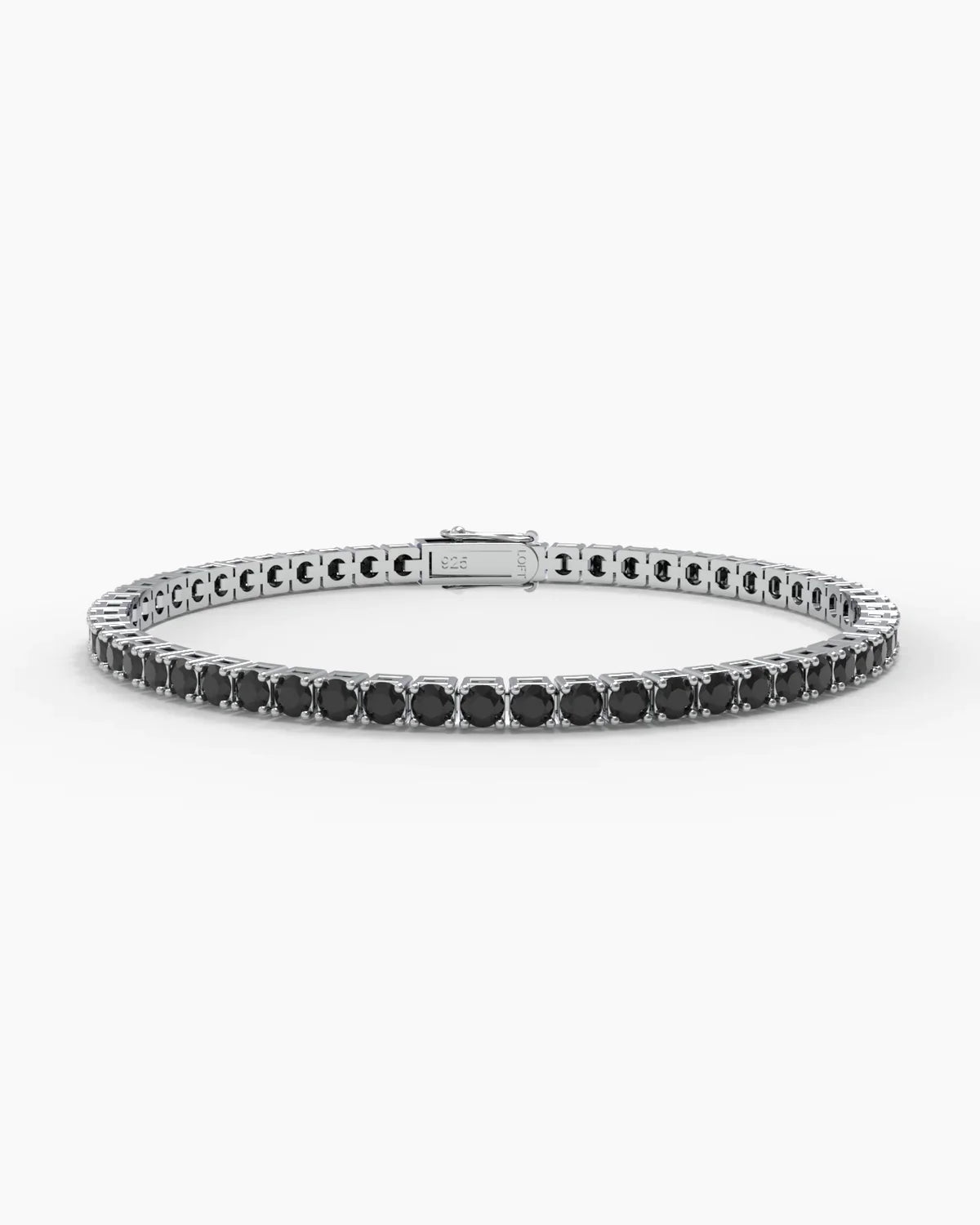
Article: Knife-Edge Tennis: What It Is, How It Differs and How to Choose Yours

Knife-Edge Tennis: What It Is, How It Differs and How to Choose Yours
Among the many interpretations of the classic tennis bracelet, few have an identity as striking as Knife-Edge Tennis. Recognized by its slim, elongated metal links, inspired by the blade of a knife and alternating with precious stones, this construction creates a piece of jewelry with precise lines, punctuated brilliance and a contemporary presence.
In this guide, you will learn what a Knife-Edge Tennis piece is, how it differs from the traditional design, and what to consider when choosing the stone, metal, size and finish of your jewelry.
Also explore the Loft Masculino Tennis Collection, featuring different interpretations of this jewelry classic.
What Is a Knife-Edge Tennis Bracelet or Necklace?
Knife-Edge Tennis is a piece of jewelry made of precious stones alternating with narrow, elongated metal links. These links create lines that visually resemble the edge of a blade, which is where the design gets its name.
In the interpretation developed by Loft Masculino, the stones are set individually in crown-style settings and connected by articulated links. This construction gives each gem its own focal point, while the metal plays a more visible role in the design.
The result is different from the continuous sparkle of a traditional tennis piece. With Knife-Edge, the eye perceives a rhythmic sequence of metal, light and color.
In short, the design features:
- Slim, elongated metal links;
- Stones set in individual settings;
- An articulated structure;
- Brilliance distributed in distinct points;
- Precise, geometric lines;
- Visual balance between stones and metal.

This composition can be applied to a men's tennis bracelet as well as a Knife-Edge Tennis necklace.
What Is the Difference Between a Traditional Tennis Bracelet and Knife-Edge Tennis?
The main difference lies in how the stones and the metal are distributed.
In a traditional tennis piece, the stones usually sit side by side, forming a virtually continuous line of sparkle. The metal structures that hold the gems remain visually in the background.
In Knife-Edge Tennis, the stone settings alternate with elongated links. As a result, the metal is no longer just a structure and becomes a central element of the design.
| Feature | Traditional tennis | Knife-Edge Tennis |
|---|---|---|
| Visual construction | Continuous sequence of stones | Stones alternating with elongated links |
| Sparkle distribution | More continuous and intense | Punctuated and rhythmic |
| Metal presence | More understated | A central part of the design |
| Aesthetic | Classic | Geometric and contemporary |
| Stone emphasis | The set as a whole | Each stone individually |
| Visual feel | Fuller | More linear and lighter |

Neither construction is necessarily superior to the other. The choice depends on the effect you want.
The traditional tennis design prioritizes the continuity of the stones. Knife-Edge Tennis highlights the contrast between the brilliance of the gems and the precision of the metal links.
To learn more about the classic construction, also read the article Men's Tennis Jewelry: A Masterpiece of Fine Jewelry.
Why Is It Called Knife-Edge?
The name refers to the narrow, linear shape of the links that connect the stones.
Seen from above, these elements form elongated metal lines reminiscent of the edge of a blade. This is precisely what creates the piece's geometric identity and sets Knife-Edge apart from other tennis designs.
In the Loft Masculino design, the elongated links represent strength and precision. The crown-style settings, in turn, interrupt these lines at regular intervals, creating individual points of sparkle or color.
This alternation gives the piece movement without relying on large stones or a fully paved surface.
Is Knife-Edge Tennis for Men or Women?
Knife-Edge Tennis can be worn by both men and women.
The design has earned its place in men's jewelry thanks to its straight lines, balanced proportions and a less traditional presence than a tennis piece made entirely of stones. However, these same qualities also appeal to women looking for jewelry with a more geometric, contemporary aesthetic.
The difference usually lies more in how it is worn than in the piece itself.
Men often choose versions with black diamonds, sapphires or dark finishes. Women also look for these options, as well as combinations with white diamonds, emeralds and light-toned or yellow metals.
That is why, although Loft Masculino is at its core dedicated to creating jewelry for men, the design does not need to be limited by gender. What matters most is choosing a combination that reflects the personality of the person who will wear it.
Which Stones Can Be Used in Knife-Edge Tennis Jewelry?
The term Knife-Edge describes the design of the piece, not a specific stone.
A Knife-Edge bracelet or necklace can be made with diamonds, black diamonds, sapphires, emeralds and other stones. Each choice changes the intensity, color and visual perception of the piece.
Knife-Edge Tennis with black diamonds
Black diamonds create a composition with an intense presence and striking contrast. Because they reflect light differently from colorless diamonds, they offer darker, deeper points of sparkle.

This option pairs especially well with black rhodium, white gold and yellow gold. With dark finishes, the stones and metal can form a more visually uniform surface. With light or yellow metals, the contrast becomes more pronounced.
Discover the Knife-Edge Tennis Bracelet with 2 mm, 3-point natural black diamonds.
Knife-Edge Tennis with diamonds
Colorless diamonds offer a brighter, more open sparkle. Alternating with the Knife-Edge links, they create well-defined points of light along the bracelet or necklace.

It is an ideal choice for those who want a luminous piece but prefer a design with a stronger metal presence than a traditional tennis bracelet.
See the Knife-Edge Tennis Bracelet with 2 mm, 3-point natural diamonds.
Knife-Edge Tennis with sapphires
Blue sapphire adds depth of color to the design. Its blue creates an elegant composition with white metals and can also produce an interesting contrast with yellow gold.
In Knife-Edge Tennis, each sapphire appears separately between the metal links. This allows the color to be seen at regular points, without forming a completely continuous blue line.

Discover the Knife-Edge Tennis Bracelet with 2 mm, 3-point natural sapphires.
Knife-Edge Tennis with emeralds
Emeralds transform the piece through their green hue. Because natural stones can show slight variations in color and internal characteristics, each composition has an identity of its own.

Green stands out in light metals as well as in yellow gold. In versions with a dark finish, the result tends to be more intense.
See the Knife-Edge Tennis Bracelet with 2 mm, 3-point natural emeralds.
Natural, Lab-Grown or Simulant Stones: What to Look For
Not every piece advertised as Knife-Edge Tennis uses natural stones.
The name identifies the style of construction. This means you can find pieces with natural diamonds, lab-grown diamonds, moissanite, cubic zirconia, crystals or other alternatives.
Before you buy, check:
- Which stone is used;
- Whether it is natural, synthetic or a simulant;
- The size of each individual stone;
- The approximate carat weight;
- The metal used in the piece;
- Whether a certificate of authenticity is included;
- The warranty and maintenance terms.
Cubic zirconia, for example, can visually reproduce certain points of sparkle, but it does not have the same composition, rarity or value as a natural diamond. Likewise, a plated piece and a piece made entirely of 18k gold belong to different categories.
That is why comparing only the shape or the price can lead to the wrong conclusion. You need to evaluate the stone, the metal, the construction and the finish together.
Knife-Edge Tennis in Sterling Silver or 18k Gold: Which Should You Choose?
The choice between silver and gold depends on the purpose of the piece, your planned budget and the preference of the person who will wear it.
Knife-Edge Tennis in 925 sterling silver
925 sterling silver makes the Knife-Edge design accessible with a smaller investment. Depending on the model, it can also receive different finishes and platings, changing the final look of the piece.
It is an appealing alternative for those who want to explore the design, try different combinations or choose a piece with natural stones without going straight to gold.
When plating has been applied, it is important to follow the care recommendations and keep in mind that the finish may need maintenance over time.
Knife-Edge Tennis in 18k gold
18k gold is recommended for those looking for a piece with greater intrinsic value who intend to keep it for many years.
The construction can be made in different shades of gold, allowing you to create contrast or continuity with the chosen stones. Black diamonds, for example, produce completely different effects when paired with white gold, yellow gold or dark finishes.
Your choice should not be based on the upfront cost alone. It is also important to consider how often you will wear it, what the piece means to you and the combination of metal and stones you want.
How to Choose Your Knife-Edge Tennis Bracelet Size
A tennis bracelet needs enough room to move with the wrist, but it should not be overly loose.
When the piece is too loose, it can constantly rotate, knock against surfaces and suffer more friction. When it is too tight, it can restrict movement and feel uncomfortable.
To measure correctly:
- Wrap a measuring tape around your wrist;
- Keep the tape against your skin without tightening it;
- Write down the circumference in centimeters;
- Add approximately 1 cm (0.4 in) for a more comfortable fit;
- Compare the measurement with the sizes available for the product.
You can also use a strip of paper, thread or string. Mark where the ends meet and then measure the length with a ruler.
Check the Loft Masculino Size Guide before making your final choice.
How to Choose Your Knife-Edge Tennis Necklace Size
With a necklace, the length directly influences how the piece will be perceived.
A shorter necklace tends to sit close to the base of the neck and stands out more when worn on its own. Mid-length options offer more ways to pair it with T-shirts, shirts and other necklaces. Longer styles create a more pronounced vertical line.

To choose:
- Measure a necklace that already fits you comfortably;
- Place a tape measure or string around your neck;
- Note the height at which you want the tennis necklace to sit;
- Consider the type of clothing you plan to wear it with;
- Avoid layering pieces that could cause constant friction.
See the Necklace Size Guide.
How to Wear Knife-Edge Tennis Jewelry
The geometry of Knife-Edge allows the piece to stand as the main statement or to be part of a broader stack.
Worn on its own
This is the most direct way to showcase the design. Without other bracelets or necklaces nearby, the links and stones can be seen more clearly.
On a bracelet, the result is precise and balanced. On a necklace, the sequence of stones creates points of light around the neck without forming a fully paved surface.
With a watch
Knife-Edge Tennis can be paired with a watch, but constant contact between the two pieces can cause scratches and wear.
To protect the surfaces, wear the tennis bracelet and the watch on opposite wrists. If you choose the same wrist, make sure there is enough space to avoid frequent impact.
Visually, metals in similar tones create continuity. Contrasting combinations, such as a steel watch with a black-finish tennis bracelet, create more separation between the pieces.
With other bracelets
In a stack, Knife-Edge works well with plain bracelets or simple-lined bangles.
Avoid combining too many pieces with stones of the same size and intensity. When several elements compete for attention, the signature design of the links can lose its impact.
A balanced stack usually features one main piece and other supporting elements.
What to Evaluate Before Buying a Knife-Edge Tennis Bracelet or Necklace
Beyond appearance, look at the aspects that determine the category and quality of the piece.
1. Origin and type of stones
Confirm whether the stones are natural and whether this information is clearly stated in the product description.
2. Uniformity
In a tennis piece, neighboring stones should be well matched in size and tone. Slight variations can occur in natural gems, especially emeralds, but the piece as a whole should maintain visual balance.
3. Link structure
The links need to follow the movement of the bracelet or necklace without compromising the alignment of the stones.
4. Clasp security
Because a tennis piece is made up of many articulated parts, the clasp must be suited to the weight and purpose of the piece. Also check for additional safety locks, where applicable.
5. Metal and finish
Distinguish between 925 sterling silver pieces, plated pieces and jewelry made in 18k gold. This information affects value, care and maintenance.
6. Certificate and warranty
Look for jewelry that comes with a certificate of authenticity and choose companies that offer after-sales support.
Loft Masculino jewelry comes with a lifetime warranty against manufacturing defects, according to the terms applicable to each product.
Find the Right Knife-Edge Tennis Piece for You
Choosing a Knife-Edge Tennis piece involves more than deciding between a clear or colored stone.
You need to consider how the metal contributes to the design, the level of sparkle you want, the size of the piece, the origin of the stones and how the piece will be worn.
Black diamonds create depth. Colorless diamonds deliver brilliance. Sapphires add an intense blue. Emeralds transform the design through color. In every version, the Knife-Edge links preserve the collection's precise, linear identity.
Explore the Loft Masculino Knife-Edge Tennis pieces and find jewelry designed to express your identity.
Precision. Presence. Impact.

Written by Carlos Macedo